Here’s how it goes, and if you run any kind of self-hosted fleet you already know the shape of it. You stand up a service. It ships with a notifier, because everything ships with a notifier now, that’s just what “production-ready” means to a framework author in 2026. You wire it up. It works. Six months later you’ve done that a dozen more times, and your phone buzzes thirty, forty times a day, and something like two-thirds of those messages are marked “high priority” by code that has never once been asked what priority actually means in your life.
You stop reading them. Not on purpose, nobody decides to stop reading their alerts. It just happens, the way your eyes slide past a browser notification you’ve seen a hundred times. And that’s the actual failure, not the volume. Volume is annoying. Volume you can complain about at a barbecue. The real damage is quieter: the one message in the pile that means something is now sitting next to fifty that don’t, wearing the exact same visual weight, the exact same “high priority” tag, and you have trained yourself, correctly, given the evidence, to treat that whole channel as background noise.
I’ve watched this happen to enough setups, mine included, more than once, that I no longer believe it’s a tuning problem. You cannot mute your way out of it. Muting is alert-by-alert triage and the flood is systemic. The fix isn’t a better filter. It’s a different architecture for how information is allowed to reach you at all.
The trap, precisely
The mechanism is worth naming because it’s not obviously dumb at any single step. A service author writes a health check. They wrap it in a notifier because shipping without one feels irresponsible. They mark the failure case as high severity, because from inside that one service, a failure genuinely is high severity, to that service. It doesn’t know about the other forty things also declaring themselves high severity today. It has no view of your calendar, your sleep, or the fact that three other services just told you the same thing about a shared dependency going down.
That’s the trap. Priority gets decided locally, by the thing least qualified to decide it, and then broadcast globally as if it were an objective fact. Every service is the main character of its own alert. Multiply that by the number of services in a fleet that’s been growing for a year or two, and you get a stream where “high priority” has been diluted into meaning almost nothing, a label everyone slaps on because the alternative (admitting a failure might be routine) requires the service author to know something about your life they can’t know.
The dangerous failure mode isn’t that you’re annoyed. It’s that annoyance is a rational response to bad information, and the rational response to a firehose of bad information is to stop drinking from it. You’ll skim the subject lines. You’ll archive on sight. And somewhere in month eight, the message that actually needed you, a real outage, a disk that’s actually full, an auth layer that’s actually down for everyone, arrives dressed identically to the forty routine ones you skimmed that morning, and it gets the same half-second of attention. That’s not a hypothetical. That’s the median outcome of “we’ll deal with alerting later.”
Fix one: a single source of truth for what’s even being watched
Before you can fix how alerts reach you, you have to fix a quieter problem underneath it: does anyone actually know what’s supposed to be monitored?
In a fleet that grew organically, the honest answer is usually “sort of.” You’ve got a watchdog script that checks some things. A dashboard that shows other things. Maybe an uptime checker with its own list, built at a different time, by a past version of you with different opinions about what mattered. These lists drift. They always drift, because updating four places every time you add or retire a service is a chore nobody does consistently, and the moment you skip it once, the lists are lying to you and you don’t know which one.
The fix here isn’t clever. It’s a single file, a registry, a small database, whatever storage you’re already comfortable with, that is the one place which says what is monitored, at what interval, at what severity, owned by whom. Everything else derives from it. Your uptime checker reads it instead of maintaining its own list. Your dashboard reads it. Your watchdog reads it. There is exactly one place to add a service, and exactly one place to remove one.
The payoff isn’t elegance for its own sake, it’s what happens when something’s missing. If a service isn’t in the registry, it isn’t monitored, and that absence is now a visible, checkable fact instead of a silent gap nobody notices until the outage that reveals it. You can literally diff the registry against what’s actually running and get a list of orphans: things running that nobody’s watching, and things being watched that no longer exist. I run that diff on a schedule now. It’s the single cheapest check I know of for catching monitoring drift before it becomes an incident postmortem that starts with “wait, we were alerting on that? I thought we retired it in March.”
There’s a sharper version of this rule worth stating directly: two monitoring systems that disagree are worse than one that’s occasionally wrong. A single system with known blind spots, you can reason about, you know where the edges are. Two systems with independent, undocumented views of reality means every incident starts with a credibility argument between your own tools before you’ve even started debugging the actual problem.
Fix two: deny-by-default at the notification layer
Registry solves “what’s being watched.” It says nothing about “what reaches a human, and when.” That’s a separate layer, and conflating the two is exactly how you end up with every service’s notifier wired straight to your phone.
The pattern that actually works is a central gateway that every service posts events into, sitting in front of a policy layer that decides what gets through. Not the service. The policy. This is the part people skip because it feels like the boring middleware nobody wants to build, and it’s also the single highest-leverage piece of the whole architecture.
Default behavior is deny, or more precisely, default to a digest, not a real-time interruption. An event lands, it gets logged, it gets folded into whatever periodic summary you’ve configured, and it does not buzz your phone unless a rule you personally wrote says it should. Interruption is a privilege a message has to earn by matching an explicit rule, not a default every service gets by showing up.
And critically: priority gets assigned by the policy layer, not self-declared by the sending service. A service saying “this is high priority” is a data point the policy can use, but it is never the final word, because, again, every service thinks it’s important. That’s not a flaw in any individual service’s code. It’s a structural fact about writing software from inside one narrow view of a system. The gateway is the first place in the pipeline with a wide enough view to actually rank things, because it’s the only component that sees the whole picture: what else fired today, what’s flapping versus what’s a fresh failure, what’s inside a maintenance window you already told it about.
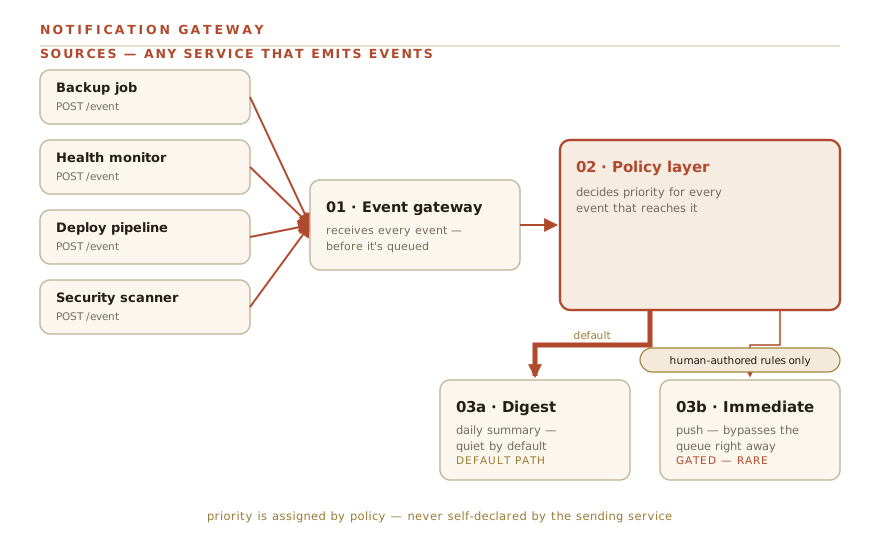
Practically, this means writing rules, and writing fewer of them than you’d expect. Something like: auth-layer failures interrupt immediately, always. Disk usage above a hard threshold interrupts. Anything that’s been failing continuously for more than an hour without resolving escalates once, not on every check cycle. Everything else, the transient blips, the routine restarts, the “service came back up in nine seconds” events that don’t require action from anyone, goes to a digest you read once a day, on your schedule, not the service’s.
Fix three: design the notification for the human on the other end
Even with a clean registry and a policy gateway, you can still build something exhausting if you don’t think about the shape of the messages themselves.
A few rules I hold onto.
Digest routine events instead of pushing each one live. If a service restarts and self-heals, that’s a data point for a daily summary, not a 2am buzz. Save real-time push for things that need a decision from you in the next few minutes, because that’s the only category where interrupting a person is actually worth the cost of interrupting a person.
Build mute buttons that actually persist. This sounds too obvious to write down, and I’m writing it down because I’ve seen (and built) mute functionality that quietly resets on a service restart or a config reload, so a thing you deliberately silenced starts paging you again a week later with zero warning. A mute that doesn’t survive a restart isn’t a mute. It’s a snooze with extra steps, and it teaches you the same lesson as everything else in this piece: don’t trust this channel.
Escalate on state change, never on state. This is the one that turns “polite” alerting into something that actually respects your attention. A service that’s down should tell you once, clearly, when it goes down. It should tell you again when it comes back up. What it should not do is remind you every five minutes that it’s still down, as if you’d forgotten, as if repetition were somehow informative. Down-to-up and up-to-down are the only two events worth a message; “still down” is not new information, it’s the same information wearing a fresh timestamp, and treating it as newsworthy is exactly the instinct that built the firehose in the first place.
And run a periodic audit, on a real cadence, not “whenever I remember to.” Count messages per day. Count how many of them required you to actually do something versus how many you archived unread. That ratio, actionable over total, is worth treating like an SLO, something you track and defend, not a vague sense of “yeah it’s been noisy lately.” If the number’s bad, it tells you exactly where to go fix a rule. If you don’t measure it, you just get a vague, growing dread every time your phone buzzes, and dread isn’t actionable.
Why any of this is worth doing
The payoff isn’t a quieter phone, although you get that too. The payoff is that when a message does interrupt you, you move, immediately, without the half-second of “is this one of the fake ones” hesitation that a noisy channel trains into you. That hesitation is the actual cost of alert fatigue, and it’s not a productivity nuisance. It’s a real gap between “something is wrong” and “a human is responding to it,” and that gap is where damage accumulates in any system, self-hosted or otherwise.
Trust isn’t something you announce into a channel. It’s something a channel earns by being right often enough, and specifically by being quiet often enough, that when it finally does speak up you don’t need to think twice. That’s not a monitoring feature. It’s what the whole architecture was for.
None of the three fixes here are individually clever. A registry is just a file. A gateway is just a service that decides yes-or-no. A mute button is just a flag that’s supposed to stick. The reason alert fatigue survives in so many fleets anyway is that none of that is glamorous work, and it’s much easier to add one more notifier to one more service than to sit down and build the layer that decides which notifiers get heard. But that’s the actual job. Tuning alerts one at a time is treating the symptom. Deciding, structurally, who’s allowed to interrupt you and under what conditions, that’s the fix that holds.